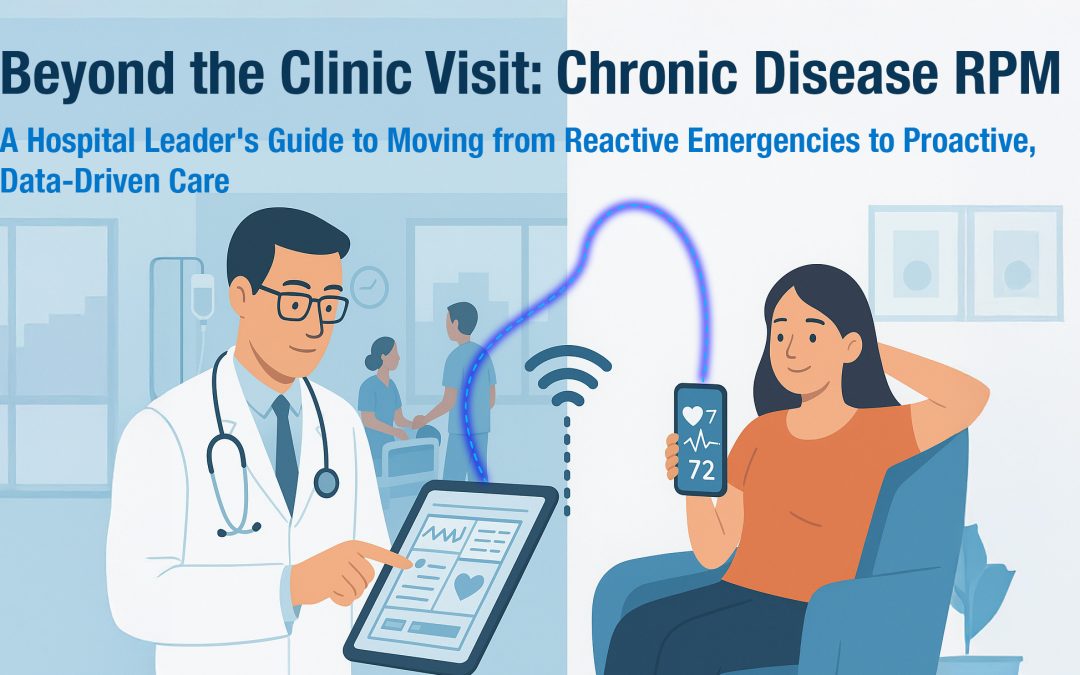
A Hospital Leader’s Guide to Moving from Reactive Emergencies to Proactive, Data-Driven Care.
For hospitals, healthcare providers and patients, the real cost of chronic disease isn’t the medication—it’s the unpredictable, high-cost emergency. It’s the 6 AM emergency room visit for a stroke due to uncontrolled hypertension or the avoidable admission for a diabetic patient.
The problem is that our traditional care model is reactive. We wait for the patient to feel sick. This creates a “revolving door” that drains clinical resources, burns out staff, and drives up financial losses to patients.
A Remote Patient Monitoring (RPM) program for chronic disease is the hospital leader’s strategic shift from “reactive” to “predictive.”
It is not just “tech”; it’s a new operational model that provides adherence tracking, continuous data monitoring, and enables data-driven consultations. It builds a “digital safety net” outside the hospital walls, allowing your team to find the problem days before the patient does.
Which Chronic Diseases Are Most Suitable for RPM?
An RPM program delivers the highest return on investment (ROI) when focused on conditions that are high-cost, high-volume, high-value from compliance and where daily patient behaviour is critical.
A “general” program is not a strategy. A specific one is. Here are the operational approaches for the four most common high-impact conditions.
1. Hypertension (HTN) Management
Clinical Goal: To drive medication and monitoring adherence, providing a long-term data log to help doctors optimize treatment and prevent strokes or cardiac events. For hospital management, this is a core risk-reduction strategy. A single, preventable stroke is a catastrophic clinical and financial event. This approach is designed to prevent it.
| Operational Element | RPM Strategy |
| Data to Track | Daily AM/PM Blood Pressure (weight and HR/HRV optional) readings. This dual-reading approach is critical to identify patterns like “morning hypertension,” which is a high-risk indicator often missed in traditional, sporadic clinic visits. |
| Adherence Strategy | The platform automates reminders (SMS, call) and flags “missed readings.” A nurse’s dashboard shows at a glance if a patient has been non-adherent for 3+ days. This triggers a proactive “adherence check-in” call, which is often educational (e.g., “I forgot”) or logistical (e.g., “My cuff broke”). |
| Example Alert Logic | IF BP > 160/100 (for 2 days)-P2 Alert (Nurse Triage) IF BP > 180/110 (single reading) -P1 Alert (Urgent Clinical Review) |
| Data-Driven Consultation | A nurse receives a P2 alert, holds a 5-minute tele-consult, and discovers the patient stopped their medication due to side effects. The intervention is simple, low-cost, and just prevented a future hypertensive crisis. |
2. Congestive Heart Failure (CHF) Management
Clinical Goal: To prevent “revolving door” readmissions by catching the earliest signs of fluid retention before the patient becomes symptomatic.
| Operational Element | RPM Strategy |
| Data We Track | Daily morning weight (on a smart scale), daily BP, and SpO2. |
| Adherence Strategy | Daily reminders are focused on the morning weight. This single data point is the most critical leading indicator for a CHF exacerbation. |
| Example Alert Logic | IF Weight > +1.5kg in 24h -P2 Alert (Nurse Triage) IF Weight > +2.5kg in 48h OR SpO2 < 90% -P1 Alert (Urgent Clinical Review) |
| Data-Driven Consultation | The platform flags a 1.5kg weight gain. The nurse calls the patient, confirms no dietary change, and (per protocol) adjusts their diuretic dosage. A 5-day, high-cost admission is prevented. |
3. Diabetes (Type 2) Management
Clinical Goal: To track adherence and analyze long-term glucose trends, helping clinicians make adjustments that prevent severe hyper- or hypoglycemic events and long-term complications.
| Operational Element | RPM Strategy |
| Data to Track | Daily fasting and post-meal glucose readings (from a connected glucometer/CGM, Optionally weight). |
| Adherence Strategy | The platform tracks adherence to the testing schedule (e.g., “fasting + 2 post-meal checks”). Non-adherence flags the patient for an educational follow-up. |
| Example Alert Logic | IF Glucose < 70 mg/dL (hypoglycemia) -P1 Alert (Urgent Patient Call) IF Glucose > 300 mg/dL (for 2 days) -P2 Alert (Medication Review) |
| Data-Driven Consultation | Instead of just seeing a 3-month A1c, the doctor reviews a 30-day glucose log, identifies a clear pattern of post-dinner spikes, and makes a specific, data-driven adjustment to the patient’s insulin. |
4. COPD Management
Clinical Goal: To reduce the frequency and severity of exacerbations (which almost always lead to emergency visits) by catching dips in oxygen saturation early.
| Operational Element | RPM Strategy |
| Data to Track | Daily SpO2 (oxygen) readings, logged symptoms and regular spirometer (e.g., “breathing difficulty”). |
| Adherence Strategy | Simple daily “check-in” reminders for the patient to take their SpO2 reading when they feel at rest. |
| Example Alert Logic | IF SpO2 < 92% (for 10 mins) -P2 Alert (Nurse Triage) IF SpO2 < 88% OR Patient reports ‘Severe’ -P1 Alert (Urgent Clinical Review) |
| Data-Driven Consultation | A P2 alert for 91% SpO2 triggers a nurse check-in. The nurse coaches the patient on “pursed-lip breathing” and schedules a tele-consult with the doctor to review their rescue inhaler usage, preventing a full-blown exacerbation. |
How the RPM Program Will Feel
Adopting an RPM program is a significant operational shift. Here is what it feels like for both your patients and your team.
For the Patient:
It feels like a “digital safety net.” They feel more connected and secure, which increases patient satisfaction, patient engagement and ownership in the treatment process.
- Simple Start: They are sent home with a simple, pre-configured “kit” (e.g., a BP cuff and smart scale).
- Simple Task: They take their readings once a day. The data transmits automatically. There are no complex apps to log into or passwords to remember.
- Simple Connection: They feel more connected to their care team. They know someone is “watching the data,” which gives them and their families incredible peace of mind.
For the Clinical Team (From a Management View):
It feels like “control.”
- It is NOT “more data”: This is the biggest fear of hospital management and staff. A well-run RPM platform does not flood your team with thousands of “normal” readings.
- It IS “smarter alerts”: It uses the Personalized Alert Matrix (as shown in the tables above) to filter the noise. 99% of the data is simply logged. Your team only sees the 1% that matters.
- It shifts the workflow: Your nurses’ day is no longer just a series of reactive, inbound phone calls. It becomes a proactive, data-driven workflow. They start by reviewing a simple dashboard of “at-risk” patients, allowing them to manage a larger patient panel far more efficiently.
The Benefits in Each Case: A Clear Business Case
By moving to this proactive, predictable care model, the benefits are tangible and measurable across the board:
- Financial ROI: It’s not just about cost savings; it’s about Patient Lifetime Value (LTV).
- Maximize Retention: Chronic patients often “doctor shop” or drift away. RPM creates a continuous “digital tether,” ensuring their long-term care (pharmacy, diagnostics, consults) stays within your hospital ecosystem.
- New Revenue Streams: You can monetize this service as a premium “Digital Care Package.” Furthermore, smart alerts convert unpaid, ad-hoc queries into structured, billable tele-consults or necessary in-clinic visits, plugging revenue leakage.
- Clinical Outcomes: You see more stable long-term outcomes, such as better A1c levels (for Diabetes) and a reduction in severe events like strokes (for HTN). Improved patient adherence to treatment plans, leading to better long-term health management.
- Operational Efficiency: Your clinical teams are no longer just “fighting fires.” They are working at the peak of their clinical skills, managing at-risk patients proactively from a single dashboard, and protecting them from “alert fatigue.”
For hospital management, this all adds up to a more efficient, more profitable, and higher-quality chronic care service. It allows you to protect your patients and your bottom line at the same time.
Ready to move from a reactive model to a proactive, predictive one?
Book a strategic demo. Our team will help you apply this guide to your hospital and design the custom alert matrix and operational workflow for your first pilot program.